
Customer Case Management for a Manufacturing Organization
Centralizing customer engagement, case creation, and support operations through a connected platform.
Executive Summary
A Customer Case Management Solution was implemented for a manufacturing organization facing challenges with manual and fragmented case creation and customer engagement processes. Limited visibility into customer issues, disconnected workflows, and inconsistent customer responses made it difficult to manage customer interactions efficiently and maintain a structured support experience.
The organization required a centralized approach that would enable teams to capture customer issues in one place, track cases more effectively, and improve engagement across multiple communication channels. The objective was to simplify customer and agent interactions, automate manual processes, and support faster response and resolution times.
To address these requirements, the Customer Case Management Solution was built using Microsoft Dynamics 365 CRM, Copilot Service Workspace, Power Automate, and Power Apps. The solution established a connected environment for case creation, tracking, workflow automation, and customer engagement, enabling customer support agents, service managers, and internal operations teams to manage customer interactions through a more structured process.
By centralizing customer case management activities within a single platform, the organization improved visibility into customer issues, reduced manual effort, streamlined customer engagement, and created a more consistent approach to managing customer support operations.
Business Challenges
Managing customer interactions through disconnected systems can create operational challenges that affect both internal teams and customer experiences.
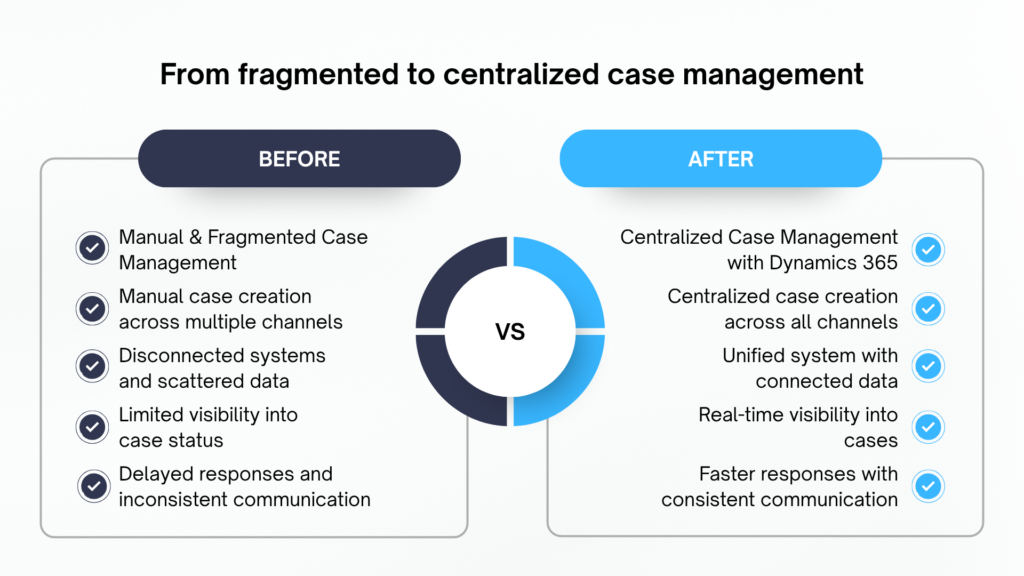
The organization was facing challenges with manual and fragmented case creation and customer engagement processes. Customer requests were being handled through multiple channels, making it difficult to maintain visibility into customer issues and ensure consistent customer responses.
Without a centralized process, support teams experienced increased operational effort while managing customer interactions. Manual activities and disconnected workflows contributed to slower case resolution and limited visibility into ongoing customer issues.
These challenges affected overall service efficiency and created barriers to delivering a consistent customer support experience.
Objectives
The organization identified several key objectives for the Customer Case Management Solution:
- Centralize Case Creation and Tracking
- Simplify Customer and Agent Engagement
- Automate Manual Processes
- Improve Response and Resolution Processes
Solution Implemented
To support these objectives, a centralized Customer Case Management Solution was implemented using Microsoft technologies designed to streamline customer engagement and case management activities.
The solution was built using:
- Microsoft Dynamics 365 CRM
- Copilot Service Workspace
- Power Automate
- Power Apps
Together, these technologies provided a connected environment for customer support operations, enabling teams to manage customer interactions and support activities through a structured workflow.
Key Features
Omnichannel Case Creation
Customer requests received through emails, phone calls, and web-based channels could be automatically converted into cases. This eliminated the need for manual case creation and ensured that customer issues were consistently captured regardless of the communication channel used.
By enabling automated case creation, the organization was able to establish a more streamlined process for managing customer interactions while improving visibility across support operations.
Customizable Case Types and Business Rules
Different customer issues often require different handling processes. To support this requirement, the solution included configurable case types with tailored fields, forms, and business rules.
This functionality allowed the organization to align case management processes with specific operational requirements. Teams could manage different categories of customer issues through structured workflows while maintaining consistency across the organization.
The ability to customize case behavior helped ensure that cases were handled according to predefined processes and business requirements.
Role-Based Approval Workflows
Managing approvals through manual communication channels can create delays and increase administrative effort.
To address this challenge, role-based approval workflows were implemented using Microsoft Power Platform technologies. Approval processes were configured based on user roles and responsibilities, allowing decisions to move through the appropriate channels automatically.
This approach simplified workflow management and helped ensure that approvals were processed in a structured and controlled manner.
Business Impact
The implementation provided a centralized approach to customer case management and engagement.
The organization gained:
- Centralized case creation and tracking
- Improved visibility into customer issues
- Reduced manual effort
- Automated workflow management
- Structured approval processes
- Streamlined customer engagement activities
Conclusion
This Customer Case Management Solution enabled the manufacturing organization to establish a centralized approach to customer engagement, case creation, and support operations.
By leveraging Microsoft Dynamics 365 CRM, Copilot Service Workspace, Power Automate, and Power Apps, the Customer Case Management Solution created a connected environment for managing customer interactions and case activities across multiple channels.
The project demonstrates how a Customer Case Management Solution can help organizations improve visibility, streamline workflows, centralize case tracking, and support a more structured customer engagement process.