
Transforming Dynamics 365 Finance and Operations SSRS Reports for Centralized Financial Reporting
D365 F&O SSRS Reports that consolidate transactions and balance calculations into centralized reports.
Executive Summary
Accurate financial reporting is essential for organizations that rely on Microsoft Dynamics 365 Finance and Operations to manage financial transactions and business operations. As transaction volumes increase, finance teams require reports that present information clearly and efficiently, enabling them to review balances, validate calculations, and reconcile financial data without unnecessary navigation through multiple system screens.
This project focused on developing D365 F&O SSRS Reports to address reporting challenges within the finance area. The implementation included customized reports and Supply Chain Management (SCM) customizations based on business requirements.
The primary objective was to consolidate financial transactions and balance calculations into centralized reports, allowing finance users to review information from a single location rather than accessing multiple forms throughout the ERP system.
The solution was developed using Microsoft Dynamics 365 Finance and Operations, X++, SQL, and SQL Server Reporting Services (SSRS), supporting finance users in their day-to-day reporting activities.
Business Challenges
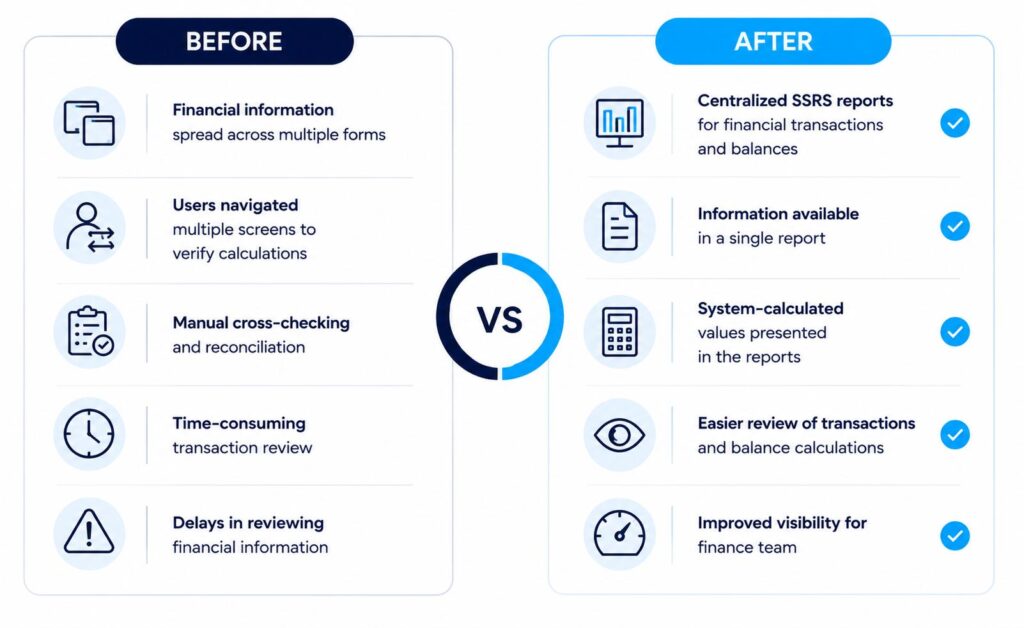
The finance team experienced difficulties when reviewing financial transactions and validating balances because the required information was distributed across multiple forms within Microsoft Dynamics 365 Finance and Operations.
To complete routine verification activities, users needed to move between different screens to review calculations, compare transactions, and reconcile financial information. This approach required additional manual effort and made the reporting process more time-consuming.
Because information was not available within a centralized report, users spent additional time locating the required data before they could complete financial reviews and reconciliation activities.
The reporting process also created delays in decision-making, as users needed to manually verify calculations before completing their analysis. The increased manual effort also raised the possibility of errors during reconciliation activities.
These reporting challenges affected productivity within the finance team and delayed period-end reviews. The organization therefore required a centralized reporting solution that would consolidate transactions and balance calculations into a single report while supporting financial analysis and validation activities.
Objectives
The project was initiated with clearly defined objectives focused on improving financial reporting within Microsoft Dynamics 365 Finance and Operations.
Improve Visibility
Develop centralized SSRS reports that consolidate financial transactions and balance calculations into one report, reducing the need to navigate through multiple forms.
Reduce Manual Effort
Present accurate system-calculated values within a centralized report to reduce manual cross-checking and reconciliation activities.
Support Financial Analysis
Enable finance users to review transactions and validate balances more efficiently using consolidated reports developed within Microsoft Dynamics 365 Finance and Operations.
Support Better Decision-Making
Provide finance users with easier access to financial information so they can review transactions and balances more effectively during financial analysis.
Solution Implemented
The solution focused on developing D365 F&O SSRS Reports that consolidated financial information into centralized reports while also implementing customizations within the Supply Chain Management module.
The reporting solution was developed using Microsoft Dynamics 365 Finance and Operations, X++, SQL, and SQL Server Reporting Services (SSRS).
Rather than requiring users to retrieve information from multiple forms, the reports were developed to present financial transactions and balance calculations within a single reporting view.
The implementation also included Supply Chain Management customizations based on business requirements provided during the project.
Key Features
Trial Balance Report
A customized Trial Balance Report was developed using SQL Server Reporting Services (SSRS).
The report provides a consolidated view of ledger balances together with system-calculated totals. This allows finance users to review balances and verify calculations without navigating through multiple forms. The report was designed to support reconciliation activities by presenting related financial information within a single report.
Project Invoice Report
The Project Invoice Report was developed to display project-related transactions together with invoice calculations. The report consolidates invoice-related information into one location, allowing finance users to review project transactions and validate invoice calculations through a single report.
Commercial Invoice Report
A Commercial Invoice Report was developed to generate commercial invoices containing complete transaction details. The report provides transaction breakdowns within a centralized report, supporting invoice review while reducing the need for manual checks across multiple forms.
Supply Chain Management Customizations
In addition to financial reporting, the implementation included customizations within the Supply Chain Management module based on business requirements. These customizations formed part of the overall implementation alongside the finance reporting enhancements.
Business Impact
The implementation addressed the reporting challenges identified at the beginning of the project by consolidating financial transactions and balance calculations into centralized D365 F&O SSRS Reports.
Instead of reviewing information across multiple forms, finance users can access transaction details, ledger balances, and invoice calculations through dedicated reports developed for financial reporting activities.
The centralized Trial Balance Report enables users to review ledger balances together with system-calculated totals from a single report. Similarly, the Project Invoice Report and Commercial Invoice Report present project transactions and invoice information within dedicated reports, reducing the need to retrieve information from multiple locations.
The implementation also supports the project’s objectives of improving visibility into financial information, reducing manual cross-checking and reconciliation activities, and enabling finance users to review calculations and validate balances more efficiently.
Supply Chain Management customizations were also included as part of the implementation based on business requirements.
Conclusion
This project demonstrates how D365 F&O SSRS Reports can be used to consolidate financial transactions, ledger balances, and invoice information into centralized reports within Microsoft Dynamics 365 Finance and Operations.
The implementation included a Trial Balance Report, Project Invoice Report, Commercial Invoice Report, and Supply Chain Management customizations developed using Microsoft Dynamics 365 Finance and Operations, X++, SQL, and SQL Server Reporting Services (SSRS).
By addressing the challenge of financial information being distributed across multiple forms, the solution provides finance users with centralized reports that support transaction review, balance validation, calculation verification, and reconciliation activities within Microsoft Dynamics 365 Finance and Operations.